Sunday, August 5, 2012

Tiramisu

Tiramisu
Tiramisu

meaning 'Pick me up' in Italian, is an Italian dessert with soaked sponge fingers and mascarpone cheese or cream layers.

We find most people prefer freshly whipped cream over mascarpone, as it is not as rich to enjoy. This dessert is best made the day prior, as all the flavours need time to combine. for a stunning dessert, this is best served in a glass bowl or dish to appreciate seeing all the layers.

½ cup cocoa
½ cup drinking chocolate
½ cup icing sugar
3 tablespoons instant coffee
3 cups warm water
4 tablespoons marsala or coffee liqueur
600ml thickened cream, lightly whipped
1 large packet of sponge fingers (savoiardi)
cocoa, for dusting


Sift cocoa, drinking chocolate and icing sugar together in a shallow dish. Add coffee and warm water gradually, stirring to remove all lumps.

Divide biscuits into 3. Dip one-third of the biscuits into the coffee mixture to cover the base of a large glass serving dish. Make sure the biscuits are really wet and full of liquid, and really soft to touch. Cover the biscuits with one-third of the cream.

Repeat layers 2 times, ending with the cream. Cover with plastic wrap and refrigerate for at least 2 hours. Dust generously with cocoa and serve.

Serves 6.

Layering the soaked sponge fingers in glass bowl


Spooning cream over sponge fingers


Sprinkling cocoa on the Tiramisu


heading out to a party

Tiramisu

Le tiramisu, qui veut dire « console-moi » en italien, est un dessert à base de biscuits à la cuillère et de crème ou de mascarpone.

Il semblerait que la plupart de gens préfèrent utiliser de la crème battue, moins lourde que le mascarpone. Il vaut mieux préparer ce dessert la veille, pour laisser à toutes les saveurs le temps de se mélanger. Nous vous conseillons de le servir dans un bol ou dans un plat en verre pour mettre en valeur les différentes couches.

½ tasse de cacao
½ tasse de chocolat en poudre
½ tasse de sucre glace
3 cuillères à soupe de café instantané
3 tasses d’eau chaude
4 cuillères à soupe de Marsala ou liqueur de café
600ml de crème épaisse légèrement battue
1 grand paquet de biscuits à la cuillère (Savoiardi)
Du cacao en poudre

Tamisez ensemble dans un plat peu profond le cacao, le chocolat en poudre et le sucre glace. Incorporez graduellement le café et l’eau chaude en remuant bien pour éliminer tous les grumeaux.

Coupez les biscuits en 3 et trempez un tiers des morceaux dans le mélange à base de café pour tapisser le fond d’un grand plat en verre. Assurez-vous que les biscuits sont vraiment mous et imbibés de liquide. Recouvrez les biscuits d’un tiers de la crème.

Répétez cette alternance entre crème et biscuits 2 fois en terminant par une couche de crème. Recouvrez d’un film plastique et réfrigérez au moins 2 heures. Saupoudrez généreusement de cacao et servez.

Pour 6 personnes.


 Dont forget to visit us on Facebook at https://www.facebook.com/pages/Mia-Cucina/121816364572861

Tuesday, July 31, 2012

Vietnamese Betel Leaves

Vietnamese Betel Leaves

The betel leaf in grown throughout South East Asia and comes from the vine of the pepper and kava families. It is commonly used for medicinal and mild stimulant properties. The betel leaf is widely used as a tobacco and the betel leaf also plays an important role in the Vietnamese culture. In Vietnamese there is a saying that "the betel begins the conversation", referring to the practice of people chewing betel in formal occasions or "to break the ice" in awkward situations.

Sourcing betel leaves in Sydney can be difficult. Try the Asian grocers in Chinatown and the Fiji markets in Newtown.

10 cloves garlic, peeled
½ cup olive oil
6 dried long red chillies, seeded
½ cup basmati rice, raw
1 x 5 cm (2 in) piece galangal, finely sliced
3 cm piece lemongrass, finely sliced
1 bunch coriander
3 kaffir lime leaves, julienned
2 tablespoons palm sugar, shaved
3 tablespoons fish sauce
4 tablespoons Chilli jam
Juice of 2 limes
1 whole smoked river trout, remove skin and flake meat
1 green mango, peeled and finely shredded
2 red eschallots, peeled and thinly sliced
20 betel leaves


Finely slice the cloves of garlic. Heat the oil in a wok or pan and shallow fry the garlic until lightly golden. Drain the garlic on absorbent paper. 


Heat remaining oil in wok, add the chillies and cook quickly until they change colour for 10–12 seconds. Remove and drain. Add raw rice to oil and cook, stirring continually until golden brown. Remove from wok and drain. Dry roast galangal and lemongrass in a pan until fragrant. Set aside to cool. 


Pound the garlic, galangal, rice, chillies, roots and stalks of the fresh coriander and kaffir lime leaves in a mortar and pestle to a fine paste.


In a small saucepan, place palm sugar, fish sauce, chilli jam and heat until sugar has dissolved. Let cool. Add lime juice.


To assemble, combine flaked trout, shredded mango, sliced eschallots and chopped coriander leaves. Add garlic chilli paste with palm sugar mixture, then gently fold together. Rinse betel leaves and let dry.


Place spoonful onto betel leaves, top with chopped fresh chilli (optional). Repeat with remaining  ingredients.


Thursday, July 19, 2012

French Onion Soup

French Onion Soup
French Onion Soup was documented during the Roman times, but in the 18th century, the French cuisine created the modern day recipe we enjoy today. Traditionally made from caramelised onions, rich beef stock and melted gruyere cheese on toasted baguettes.

Don't be distracted with less authentic recipes, cutting corners using flour and sugar to caramelise and thicken the soup. Not only does this change the flavour of the soup, but it will also create more problems along the way.

French Onion Soup

2 tablespoons olive oil
2 kgs brown onions, thinly sliced
Salt and freshly ground black pepper
4 cups beef stock
1 baguette, thickly sliced
1 cup grated gruyere cheese

Heat a heavy based saucepan over high heat. Add oil and onions and season well. Cook, uncovered, stirring often, for 45 minutes or until onions soften and then caramelise.

Add stock and reduce heat to simmer for 15 minutes.

Preheat grill. Arrange bread on a baking tray. Sprinkle cheese on bread. Grill until cheese melts. Ladle soup into bowls. Top with cheese croutons.

Finely slice onions for best results


Cooking onions until they soften


Caramelise onions for a rich robust flavour


Add beef stock and simmer a further 15 minutes


Grill cheese on baguette slices until golden


French onion Soup - Wonderful winter meal


Don't forget to visit us on Facebook at our Shared Table
https://www.facebook.com/pages/Shared-Table/121816364572861

Tuesday, July 17, 2012

What's Halal for you is Kosher for me

 A wonderful story of unity through diversity. The friendships we have made, the recipes and stories we have shared, which have brought Jewish and Muslim women together. Celebrating so many similarities in our cultures, traditions and beliefs and life long bonds we now share.

Making Kibbeh

Here is live footage with both Jewish and Muslim women being interviewed together whilst busy in the kitchen cooking....
http://www.abc.net.au/radionational/programs/rnfirstbite/rn-first-bite-sat-14th-july/4121020

Visit us on Facebook at:


Olivetree Women's Network  https://www.facebook.com/pages/Olivetree-Womens-Network/97241523636

Sunday, July 15, 2012

Truffle Hunting


What a better way to spend a cold rainy winter's day, than going on a truffle hunt. Traditionally, in Europe, truffles were hunted by the farmers pig. I do recall reading many years ago that the old greedy farmers would only take their pigs hunting either late at night or very early in the mornings when his neighbours couldn't see under which trees his truffles laid.

The black truffle or "black Périgord truffle" is named after the Périgord region in France and grows beneath oak and hazelnut trees. The truffle industry in Australia is very new, having only surfaced in the past 10 years or so. Through technological advances, the oak and hazelnut trees have been inoculated with truffle fungus, allowing farmers outside of provincial European lands to explore the truffle mystery.

Now why are truffles so exclusive, rare and mysterious? The truffle season is limited to the winter months in Australia. The rainfall during the summer months, will affect the growth and size of the truffle hunted that winter. Thus the cost ... a wooping AUD $2000 per kilo. That equates to $200 per 100gm truffle. The below truffle weighed approx 35gms = $70.


Here Colin places a leash on Morris, and as we can see, Morris has lifted his paw in preparation. Morris was excited to truffle hunt, even in the rain.

Colin wears knee pads as he spends many hours kneeling on the ground in searching for 'Black Gold'.

And the hunt begins ....

Morris was trained from a pup developing a keen sense of truffle.

Rewarded with snacks for locating a potential 'nest' of truffles

Sniffing away - Morris locates the specific area of the truffle

Double checking...

Learning how to differentiate the smell of soil from the truffle

Phoebe finding it difficult to smell where the truffle was hiding

The treasure is found!
A very happy truffle bearer boasts the 40gm truffle

Morris digs for gold as the the umbrella-ed bystanders watch on

A well deserved reward....

A family of truffles - 11 in one nest

Sopping wet but very proud

Nothing comes between a man and his dog


Learning the texture of the truffle, its shape, form, colour, texture and smell

Being inspired

The fine bristles of the old toothbrush are perfect for a gentle clean, removing all dirt without damaging the truffle's exterior

Each truffle is washed, weighed and then valued

To know the quality of your truffle, always make sure you cut off a small slice to see its inside colour. Anything lighter than caramel indicates the truffle was picked prematurely and is not ready for sale

A perfect inside colour - dark with white lines, dense in texture with an aromatic truffle aroma.

Truffle slicer give an incredible fine shave, perfect for this pungent fruit.


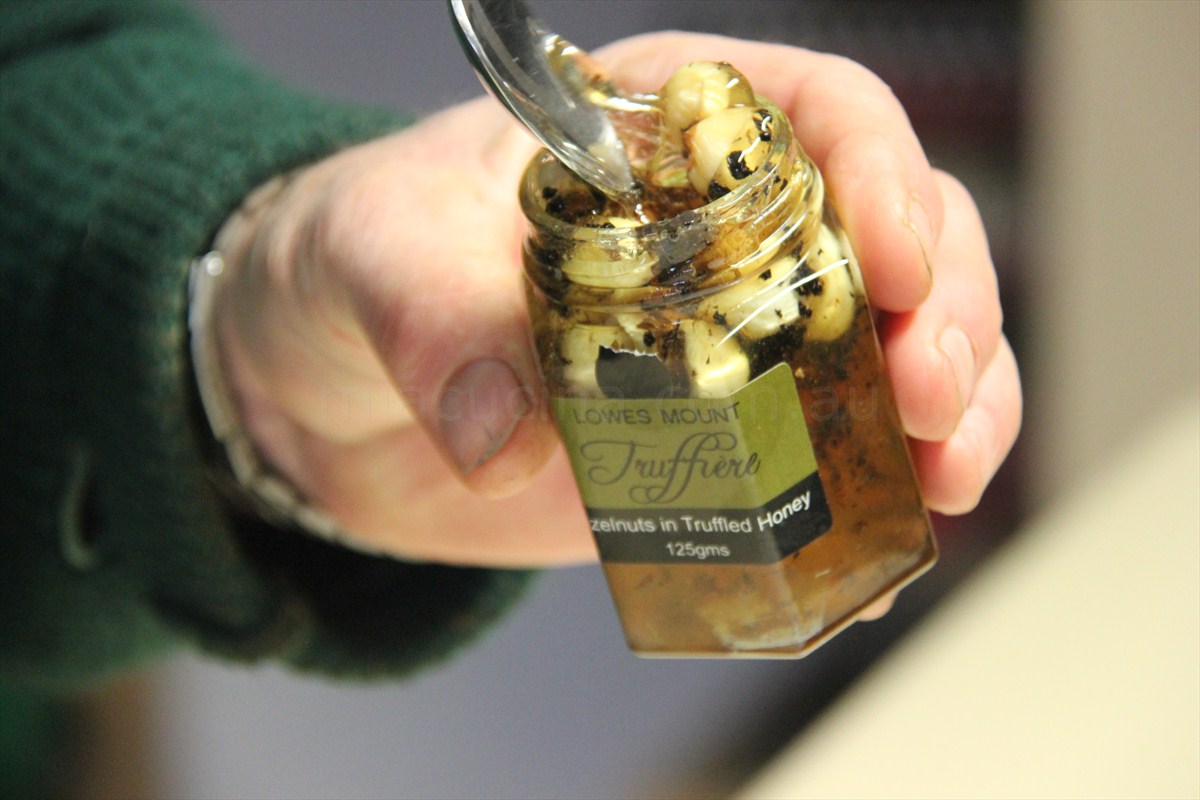
Incredibly delicious, with the freshly gathered nuts off the hazelnut tree, together with finely grated truffle, together in a jar with honey was spectacular.

and placed on top of goats curd, is sensational!


One ingredient that goes hand in hand with the truffle is eggs.
Simple omelette with shaved truffle is provincal French cooking, rich, creamy and we are just missing one thing here .... the baguette.
And how versatile is the truffle, here we enjoyed truffle ice cream with an egg yolk base. The egg whites made the almond bread.


Breakfast the following morning. We combined grated mozzarella and Parmesan cheese with freshly grated truffle....

Then we sprinkled that mixture over 12 beaten eggs in a pan ....

Cooked the bottom of the souffle ....
then flipped it in half ....

Voila ....
Here we are preparing the Truffle Hazelnut Honey, grating the fresh truffle.


Sterilised jars being filled with roasted hazelnuts

Combine the truffle with honey, and pour over hazelnuts. Seal.

Creamy mash potato with a drizzle of olive oil and shaved truffle is a wonderful accompaniment to meat, chicken or fish.


Truffles have a shelf life of 7 days, so make the most out of the brief season. Placing a small truffle in Vodka or in a jar of honey, so then it has an unlimited shelf life. Making truffle butter, placing slices under the skin of a chicken before roasting or making truffle salt.

Don't forget to visit our Shared Table on Facebook at https://www.facebook.com/pages/Shared-Table/121816364572861